
Concrete Landscaping Ideas Built to Last Through Milwaukee Winters
Table of Contents
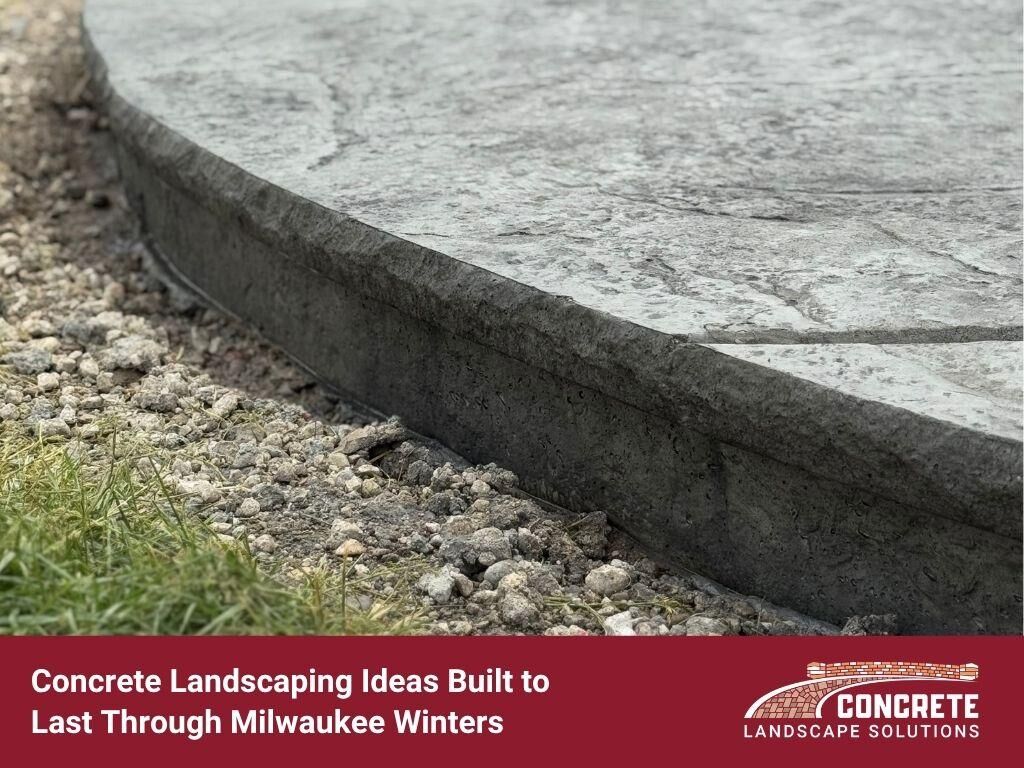
Concrete landscaping ideas like stamped patios, terraced retaining walls, and custom driveways can turn a Milwaukee yard into usable, low-maintenance outdoor space. To last, though, the concrete has to be built for Wisconsin winters. Air-entrained concrete, which holds tiny air bubbles that give freezing water room to expand, handles our freeze-thaw cycles best when it’s poured at the right strength on a compacted base.
Chad Kempf founded Concrete Landscape Solutions with his son Vann in 2024, after more than 30 years in concrete flatwork, and he’s a certified concrete tester. If you’re planning a new patio or working with a sloped yard, choosing the right style, materials, and finish early saves you time and money.
Choosing a Style for Your Concrete Landscape
Concrete has a natural style of its own. A broom-finished slab with straight edges and square corners looks modern, with cool gray tones, sharp angles, and very little ornament. That sleek look suits many homes, although it can feel out of place on others.
Concrete also works in both contemporary and rustic garden styles, and its solid surfaces create a striking contrast with softer plants, grass, and trees. To find the right direction for your yard, start with two simple questions:
- Straight lines or curves? Straight edges, square corners, and large slabs give your property a modern look. Curving edges, rounded corners, and smaller repeated shapes feel more traditional. Concrete can do either, and since the shape is set during forming, it’s one of the first things we’ll talk through with you.
- Crisp or relaxed? A single color, tight joints, and a clean banded border feel formal. Varied color, hand-tooled joints, and a softer edge where plants spill over feel more informal. For example, a Craftsman bungalow in Bay View and a new build in Mequon usually call for opposite answers.
Once you’ve answered those, choosing a finish gets easier. A broom finish with large slabs fits a modern look, while stamped patterns with warmer colors and curved edges suit a traditional one. Exposed aggregate falls comfortably in between, and it hides dirt better than either.
Settling these choices early also saves time and money. Changing a finish is a simple conversation, while changing the shape of a slab after the forms are set means tearing out work.
Concrete Landscaping Ideas for Front and Back Yards
Front and back yards usually serve different purposes. The front shapes how your home looks from the street and how guests reach the door, while the back is where you spend time outdoors. Concrete works well in both, though the details change from one to the other.
Front Yard Concrete Ideas
In most front yards, the driveway is the largest single surface, so it sets the tone for everything around it. A custom concrete driveway can include a colored border, hand-tooled joints, or a broom-finished field framed by a smooth band along the edge.
Stamped patterns can also imitate cobblestone, while exposed aggregate and colored concrete add different textures and warmth. Even small details like these give the biggest surface in your yard a finished, intentional look.

From the driveway, the walk to the door and the steps or stoop complete the approach. Curved concrete pathways soften the layout and guide guests toward the entry.
Poured concrete steps and stairs also stay in place in wet soil, where wood can rot and stacked stone can shift. As you plan the steps, keep the riser height the same across the whole run, since uneven risers are the most common step problem homeowners ask us to fix.
Concrete Patio Ideas for Your Backyard Design
Your backyard is where concrete can create a true outdoor room for cooking, dining, and relaxing. A concrete patio gives you a solid base for an outdoor kitchen, a table, and comfortable chairs, and it resists the settling that a sand-set surface can develop over time.
Good backyard design also accounts for water. A patio should slope slightly away from your house, so rain runs off instead of pooling, and raised patios need careful drainage planning from the start. Once the drainage is set, these concrete patio ideas can give the space more character:
- Replace an aging wood deck with a smooth concrete slab for a sleek, modern feel.
- Add board-formed concrete to a wall or step, which leaves a wood-grain texture on the surface.
- Build concrete planters into the patio edge to anchor greenery and soften the hardscape.
- Install lighting along steps and walls to highlight these features at night.
Fire Pit and Seating Areas
A fire pit gives a patio a natural gathering spot, and a concrete slab easily carries the weight of a stone fire pit and the seating around it. Built-in seat walls also add seating options without crowding the patio with extra chairs.
If you’re adding a seat wall, pour its footing with the slab. Tying the two together avoids a cold joint that can open up after a few winters, which is the approach we used on our retaining wall and seat wall in Franklin.
Terraced Yards and Retaining Walls
Sloped yards are where concrete makes the biggest difference. Terracing can transform a grade that’s hard to mow into flat, usable outdoor areas for lawn, gardens, or seating areas. Retaining walls can also create terraced planting beds, which add more room to grow.
Steel-reinforced concrete retaining walls support soil pressure and route water away from the house, while drainage holes near the base let water flow out from behind the wall. Taller walls may also need structural footings, and our crew sets footings below the frost line so the wall stays put through Wisconsin winters.
Large Concrete Pavers and Turf Grids
For a modern walk or patio that drains on its own, consider a slab-and-turf grid. Large concrete pavers set with open joints let you plant grass or groundcover between them, so rain soaks into the ground where it lands. The same idea is behind permeable paving, and the green joints also break up a large paved area.
For the joints, choose a plant that can make it through a Wisconsin winter in a two-inch strip of soil. Creeping thyme is the standard choice and handles light foot traffic well, while creeping sedum grows in the same conditions and tolerates our clay soil.
Groundcover veronica is a good third option, since Wisconsin Horticulture lists several varieties as hardy to zone 4a and well suited to planting between paving bricks and flagstone. These plants work best on paths with light use, so a route you walk several times a day is better off with grass or solid paving.
Concrete Structures for Seating and Water Features
Beyond patios and walls, concrete elements like built-in furniture and fountains can give your yard a unique look. These concrete structures are durable, weather-resistant, and low maintenance, which makes them a good fit for Wisconsin’s seasons.
Concrete Furniture
Concrete furniture adds a unique aesthetic to outdoor areas, and it stays put through wind and snow. Options range from benches and seat walls to tables, stools, and loungers, and a few cushions make concrete seating as comfortable as it is durable. Since it needs very little upkeep, concrete furniture also gives you more time to enjoy the space.

Concrete Fountains and Water Features
Concrete fountains can be customized to almost any shape or size, from a simple bubbling basin to a wall that spills water into a pool. The sound of water flow adds a calm feel to a garden, and a fountain can take center stage in a patio or planting bed. Because a fountain needs plumbing and power, it’s worth planning one along with the patio or wall around it.
Blocks, Pavers, and Wall Materials
Choosing wall materials comes down to three things: how tall the wall is, whether equipment can reach the work area, and whether the wall holds back soil or simply defines a space.
- Segmental retaining wall blocks. These standard interlocking units work well for walls up to about four feet tall. Above that height, the wall needs engineering and a geogrid that runs back into the soil, and any wall retaining a driveway, pool, or structure needs engineering no matter its height.
- Large concrete blocks. Sometimes called ecology or barrier blocks, these measure about 2 by 2 by 6 feet. They build tall walls and terraces quickly, but each one weighs close to two tons, so the site needs room for equipment. They’re a great fit for big grade changes and utility walls, while smaller units suit a decorative garden wall better.
- Granite boulders. Boulders give terraced beds and slope stabilization a natural stone look. Careful placement makes all the difference, since a boulder wall depends on solid ground underneath it.
- Crushed concrete. This recycled aggregate from old slabs compacts firmly, so it makes a solid base under a patio, driveway, or path. Much like gravel, it also works as drainage backfill behind a wall. As a decorative topping, though, keep it away from acid-loving plants, because the cement fines raise the soil’s pH.
- Poured concrete. Poured concrete forms one continuous surface with no joints to weed, and it can follow any curve. The trade-off is that a repair means replacing a full section.
Concrete pavers belong on this list too, and our team handles their installation as well. Pavers come in many shapes and sizes, and a paver surface can be lifted and reset if a utility line runs underneath or a section settles. That makes pavers a smart choice for a walkway over a service line, while poured concrete works best for large, continuous surfaces and custom shapes.
Finishes for Concrete Surfaces
The finish gives concrete its color and texture, so it has a big effect on the overall look of your yard. Three finishes cover most of the styles homeowners ask for.
Stamped Concrete
Stamped concrete is patterned and colored while the slab is still workable, so one pour can look like slate, flagstone, brick, cobblestone, or wood plank. It’s the finish homeowners request most often for patios and front walks, and it shows off the design range of concrete better than any other option.
A few things are worth knowing ahead of time:
- Pattern scale has to match the space, since a large flagstone pattern on a small landing can look like two stones and a seam.
- Any area that stays wet, especially a pool surround, needs a slip-resistant additive in the sealer.
- Sealing is part of every stamped project because it keeps the color from fading and stains from setting in. In this climate, plan to reseal about every three to five years. Sealing protects the surface, while air entrainment and base prep protect the slab underneath.
Exposed Aggregate
Exposed aggregate concrete reveals the small stones mixed into the slab, which gives the surface a natural, textured finish. It’s a cost-effective option that costs more than a broom finish but less than stamped concrete. The texture also hides dirt and adds grip underfoot, which makes it a practical choice for driveways, walks, and patios.
Colored and Stained Concrete
Colored concrete is a cost-effective way to turn plain gray concrete surfaces into something with more personality. Color can be mixed into the concrete with admixtures, or a stain can be applied to the surface for richer, more organic variation. Both work well on sidewalks, patios, and driveways. Since stain soaks into the surface while paint sits on top and can peel, stain is the better choice for outdoor slabs.
Winter Care for New Concrete
Whatever finish you choose, keep de-icing salt off new concrete through its first winter, and use it lightly after that. Sand adds traction without the chemicals, and it’s easier on nearby plants too. According to UW-Madison Extension, plant damage typically shows up within thirty feet of roads, driveways, and parking lots where salt is applied.
What Affects the Cost of Concrete Landscaping
Flatwork is priced per square foot, and walls are priced per square foot of wall face. Those numbers can move quite a bit from one site to the next, mainly because of these factors:
- Access. A backyard where the truck can back up to the work area is priced differently than one where every yard of concrete goes in by buggy or pump.
- Tear-out. Removing and hauling away an existing slab is its own line item.
- Base prep. Excavation depth, compacted gravel, and grading are the parts you never see, yet they decide whether the slab stays flat for years to come.
- Thickness and reinforcement. A driveway needs a thicker, stronger slab than a patio.
- Finish. A broom finish is the baseline, exposed aggregate costs more, and stamped concrete costs the most.
- Wall height. Walls taller than about four feet need engineering and geogrid.
- Season. Southeast Wisconsin’s pour window runs roughly April through November, and mid-season dates book up early.
Every project we quote comes with the price up front and in writing.
FAQs
What Is the Difference Between Stamped Concrete and Exposed Aggregate?
Stamped concrete uses patterns and color to look like stone, brick, or wood. Exposed aggregate reveals the small stones inside the concrete, which creates a textured surface that adds traction and hides dirt. Exposed aggregate usually costs less than stamped concrete and more than a standard broom finish.
When Is the Best Time to Start a Concrete Project in Milwaukee?
Southeast Wisconsin’s pour window runs roughly April through November, since concrete cures best in mild weather. Mid-season dates book up early, so reaching out in late winter or early spring gives you the widest choice of dates. Planning over the winter also leaves time to settle on a design and finish without feeling rushed.
See Which Concrete Landscaping Idea Fits Your Yard
Send us a photo of your yard, what you’d like to change, and how you plan to use the space. We’ll walk the site, explain what the base and drainage need, and give you a written price ahead of scheduling. You can also explore finished work in our project gallery, or request a quote to get started.
Concrete Landscape Solutions serves Milwaukee and Southeast Wisconsin.
